

Step-by-Step Guide to Cylindrical Rubber Fender Installation
Date:2026-03-18
Cylindrical fenders are among the most commonly used basic fender types in ports and berths. Depending on their size and load requirements, three main installation methods are commonly used.
1. Installation Methods
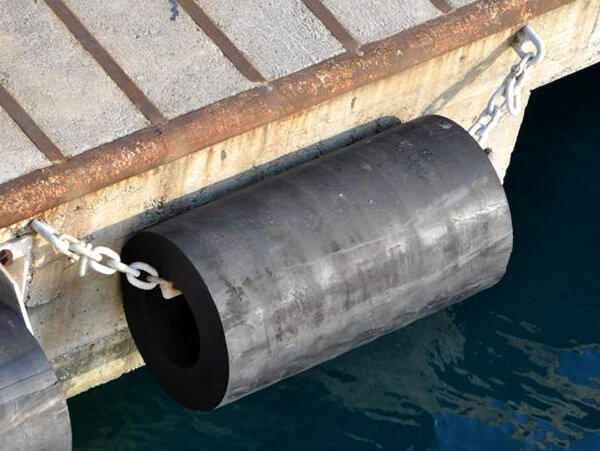
Chain Installation
Small cylindrical fenders (≤ Ø600 mm) are typically suspended using chains connected to brackets or U-anchors on the quay wall.
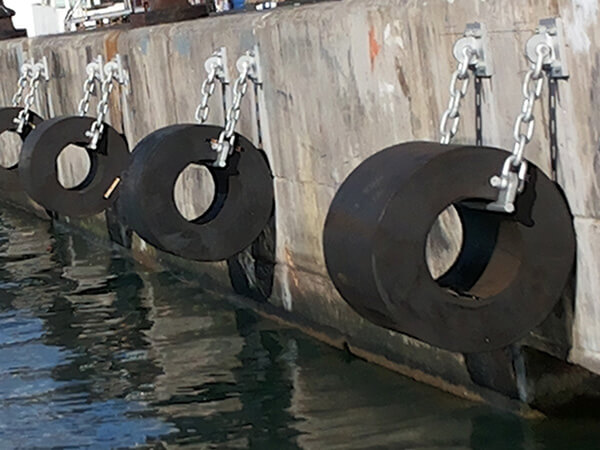
Chain and Bar Installation
Large cylindrical fenders (Ø900–Ø1600 mm) are usually installed with a central support bar. The bar is connected at both ends to chains, which are then fixed to brackets or U-anchors on the quay wall.
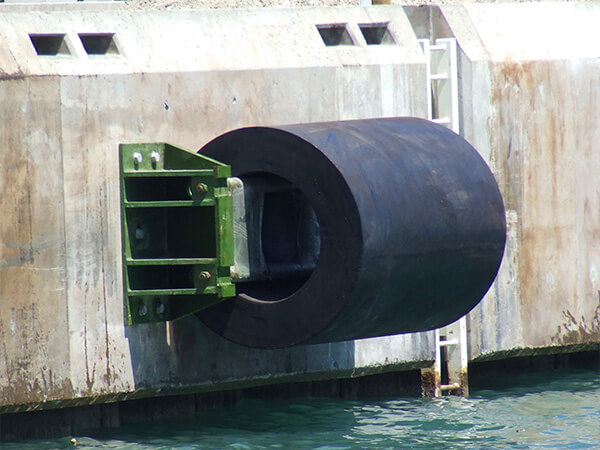
Ladder Installation
Very large cylindrical fenders (≥ Ø1600 mm) may require specially designed ladder brackets due to their heavy weight. These brackets are custom-designed for each specific application.
2. Installation Steps
Proper installation is essential to ensure the safety and long-term performance of cylindrical fenders.
First
Install Support Brackets
Install the support brackets in advance on the quay wall.
Second
Prepare the Fender
Place the fender on blockings and pass a soft sling through the central bore; for very long fenders, a spreader beam may be required.
Third
Insert Support Components
Insert the chain, support bar, or bracket through the fender.
Fourth
Lift with Care
When lifting the assembly, care must be taken to avoid damaging the rubber.
Fifth
Connect to Brackets
Lift the fender slightly higher than its final installation position before connecting it to the brackets using shackles, ensuring split pins are properly secured.
Finally
Final Adjustment
Slowly lower the fender until the chains are fully tensioned, and check that the chain angles on both sides are equal to ensure balanced load distribution and stable operation.
- Final Check
After installation, always verify that all connections are secure, chains are properly tensioned, and the fender is correctly aligned to ensure optimal performance and longevity.
Next: APM 2026 Maritime Exhibition in Singapore – Nanjing Deers
RELATED
- APM 2026 Maritime Exhibition in Singapore – Nanjing Deers
- Successfully Supply and Install Cell Fender System for Port Upgrade
- Ship Launching Airbags are Ready for shippment to Shipyard
- Dredging Pipeline Systems: Floating, Submerged, and Land Pipelines
- Nanjing Deers New Supply of DD Fenders to Vietnam
- How to Select the Right Marine Fender System for Ports and Terminals
- Supply Cell and Arch Fender Systems for Nantong Port’s 100,000 DWT Grain & Oil Berth Project
- Supply of Welded Dredge Ball Joints to a New European Client