Port Engineering: How to Transport Caissons Using Marine Airbags
Date:2026-04-10
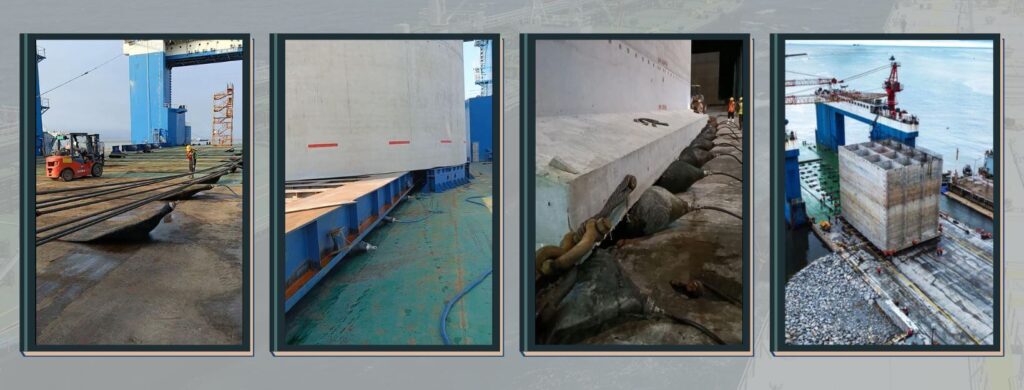
In port construction projects, the use of marine airbags for lifting and transporting caissons is an efficient, safe, and cost-effective method. To ensure operational stability and safety, several key technical considerations should be addressed.
1. Airbag Lifting and Pedestal Design
The airbag lifting system should be integrated with the pedestal design, leaving sufficient space for lifting pits. The number, specifications, and rated working pressure of the airbags must meet the safety requirements for lifting the caisson. The quantity and arrangement of lifting pits should correspond to the layout of the rolling airbags.
The effective bearing width of an airbag can be calculated using the following formula:
B = π(D – H) / 2
- D = Airbag diameter
- H = Working height of the airbag, typically 30–50 cm
2. Arrangement of Support Blocks or Timber Cribbing
The number and spacing of support blocks or timber cribbing should be determined through engineering calculations.The ground clearance should allow for the placement and removal of the airbag heads, generally not less than 270 mm.
Timber cribbing should be made of hardwood and reinforced with steel bands. Alternatively, reinforced concrete supports may be used, with a cushioning layer on top and steel plates at the base to enhance stability.
3. Ground Bearing Capacity
The arrangement of supports must satisfy the ground bearing capacity. If the bearing capacity is insufficient, 20 mm thick steel plates should be placed beneath the supports to distribute the load and improve stability.
4. Site Conditions for Rolling Operations
The lifting and rolling area must be level, compacted, and free of sharp objects, depressions, or obstacles to prevent damage to the airbags and ensure smooth transportation.
Required Conditions
- Level surface
- Properly compacted ground
- Clear transportation path
Avoid
- Sharp objects
- Depressions or holes
- Obstacles in pathway
5. Towing Equipment Configuration
Winches, steel wire ropes, and ground anchors must be properly selected to meet the towing requirements of the caisson.
Minimum Safety Factor
≥ 5
Minimum Safety Factor
≤ 2.5°
6. Airbag Inflation and Rolling Procedure
Airbag inflation valves should be symmetrically arranged, and inflation should be carried out simultaneously and gradually on both sides, starting from the center and moving outward.
Before transportation, at least five rolling airbags should be pre-arranged along the transportation path and pre-inflated as required. During the rolling operation, all non-essential personnel should be cleared from the site to maintain safety.
With proper design and standardized operational procedures, the use of marine airbags for caisson transportation significantly enhances construction efficiency, reduces costs, and ensures the safety and quality of port engineering projects.
Need engineering support?
Our team specializes in marine airbag solutions.
RELATED
- ID800 Pneumatic Fenders Ready for Operation in Southeast Asia
- Q1 2026 U.S. Dredging Tenders Overview: Key Projects & Strategic Insights
- Shipment of Orange Pipe Floats to European Dredging Project
- Why Pre-Drilled Holes are critical for dock fenders
- Customized Keyhole Fenders are Ready for Tugboat Replacement
- Expansion Joint in Dredging Pipeline: Functions, Types & Applications
- APM 2026 Maritime Exhibition in Singapore – Nanjing Deers
- Step-by-Step Guide to Cylindrical Rubber Fender Installation
