

How to Know When Marine Fenders Need Replacement
Date:2026-08-13
Marine fenders are essential safety components that protect vessels and berth structures during berthing and mooring. However, continuous compression, friction, seawater exposure, ultraviolet radiation, corrosion, marine growth, and occasional abnormal impacts can gradually reduce their reliability.
A damaged fender does not always require complete replacement. Some problems can be corrected by replacing face pads, chains, bolts, or other accessories. In other cases, deterioration of the rubber body or a loss of energy-absorption performance can make replacement the safer option.
So, how can a port operator determine whether a marine fender should be repaired, monitored, or replaced?
Service Age Alone is not a Reliable Replacement Criterion
There is no universal service-life number that applies to every marine fender. Two fenders of the same type and age can be in very different condition because their operating environments may differ significantly.
Fender condition is influenced by factors such as:
- Frequency of vessel calls
- Vessel size, hull geometry, and berthing speed
- Exposure to waves, currents, temperature changes, sunlight, and ozone
- Rubber compound quality
- Fender selection and system design
- Installation accuracy and chain adjustment
- Inspection and maintenance practices
- Accidental or abnormal berthing events
For this reason, replacement decisions should be based on the actual condition and required performance of the complete fender system—not on age alone.
1. Severe Cracks, Cuts, or Tears in the Rubber Body
Small, shallow surface cracks do not necessarily mean that a rubber fender has reached the end of its service life. Minor ozone cracking or localized surface abrasion may only require cleaning, documentation, and continued monitoring.
The situation becomes more serious when inspection reveals:
- Deep or rapidly expanding cracks
- Circumferential cracks around the fender body
- Tears near the flange or mounting area
- Large cuts caused by sharp hull features or debris
- Exposed reinforcement layers in reinforced products
- Rubber separation, delamination, or missing sections

Cracks around the base of a cone or cell fender deserve particular attention because this area transfers substantial loads between the rubber body and the berth structure. Excessive panel weight, incorrectly adjusted chains, or long-term static stress can also contribute to cracking near the fender base.
If the damage affects the load-carrying section of the fender, continues to grow, or exposes reinforcement, an engineering assessment is required. Replacement is usually safer when structural integrity can no longer be verified.
2. Permanent Deformation or Failure to Recover
Rubber fenders are designed to deform under load and return close to their original shape after the load is removed. A fender that remains heavily compressed, twisted, tilted, buckled, or sagging may no longer respond as designed.
Warning signs include:
- The fender does not recover after the vessel leaves the berth
- One side of the rubber body is permanently compressed
- The panel remains tilted even when no vessel is alongside
- The fender body has collapsed, buckled, or become visibly distorted
- Adjacent fenders show substantially different resting positions
Permanent deformation can indicate rubber aging, internal damage, over-compression, incorrect installation, or a chain system that is imposing unintended static loads. The cause should be identified before installing a replacement; otherwise, the new fender may develop the same problem.
3. Corroded, Loose, or Damaged Fixings
Bolts, anchors, chains, shackles, brackets, and other steel components are exposed to a highly corrosive marine environment. Common findings include:
- Loose or missing bolts
- Significant chain wear or loss of diameter
- Elongated chain links
- Seized or damaged shackles and swivels
- Bent brackets or anchor plates
- Cracked welds
- Advanced corrosion or coating failure
- Damaged or displaced mounting hardware

Not every hardware defect requires replacement of the rubber fender. In many cases, the affected chain, bolt, shackle, or bracket can be replaced separately. However, if damaged restraints allow excessive panel movement, sagging, twisting, or direct loads on the rubber body, the fender may have suffered secondary damage and should also be examined.
Replacement hardware must match the original design in material, dimensions, strength, corrosion protection, and function. Installing an arbitrary chain or bolt of a similar appearance may change how loads are distributed through the system.
4. Damaged Fender Panels or Worn UHMW-PE Face Pads
For panel-type systems, the steel frontal panel distributes vessel loads over a larger hull area, while UHMW-PE face pads reduce friction. Problems with either component can affect both vessel safety and fender performance.
Worn face pads can often be replaced without changing the complete fender. A severely deformed or structurally weakened panel, however, usually requires replacement or engineered repair. The rubber body should also be inspected because a major impact strong enough to deform the panel may have overloaded the fender.

Inspect the panel for:
- Permanent bending or distortion
- Cracks in the steel or welds
- Severe corrosion or section loss
- Damaged lifting or chain connection points
- Uneven loading or misalignment
Inspect the face pads for:
- Excessive wear or loss of thickness
- Cracks, splitting, or missing sections
- Loose, recessed, or exposed fasteners
- Sharp edges that could damage a vessel’s hull
- Pads that have detached from the panel
5. Repeated Failures or Increasing Repair Frequency
One isolated repair does not necessarily justify replacement. However, repeated cracking, loose hardware, recurring air leakage, frequent chain failure, or continuously detaching face pads may indicate a deeper system problem.
Possible root causes include:
- Incorrect fender selection
- Overloading or over-compression
- Poor panel geometry or excessive panel weight
- Incorrectly adjusted chains
- Vessel contact outside the intended fender area
- Misalignment between the fender and vessel hull
- Changed vessel traffic or operating conditions
- Inadequate corrosion protection
When repair frequency and berth downtime continue to increase, replacement or system redesign may be more economical than repeated temporary repairs.
6. Warning Signs for Pneumatic and Foam-Filled Fenders
Floating fenders require some additional checks.
Pneumatic Fenders
Pneumatic fenders should be taken out of service for detailed assessment if it shows:
- Persistent loss of internal pressure
- Punctures, pinholes, or air leakage
- Deep cuts or exposed reinforcement cords
- Damage near the flange opening or end fittings
- Damaged inflation or safety valves
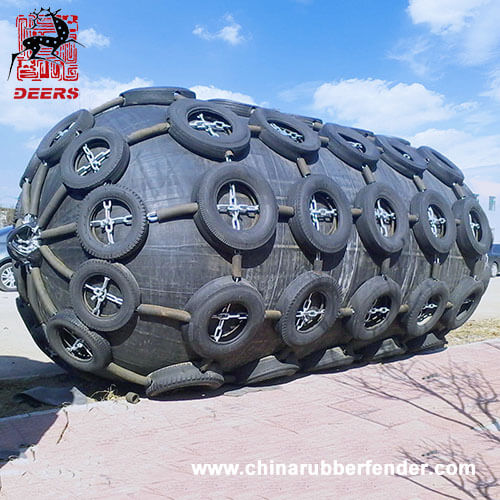
- Severely worn tire-and-chain netting
- Deformed, corroded, or cracked end fittings
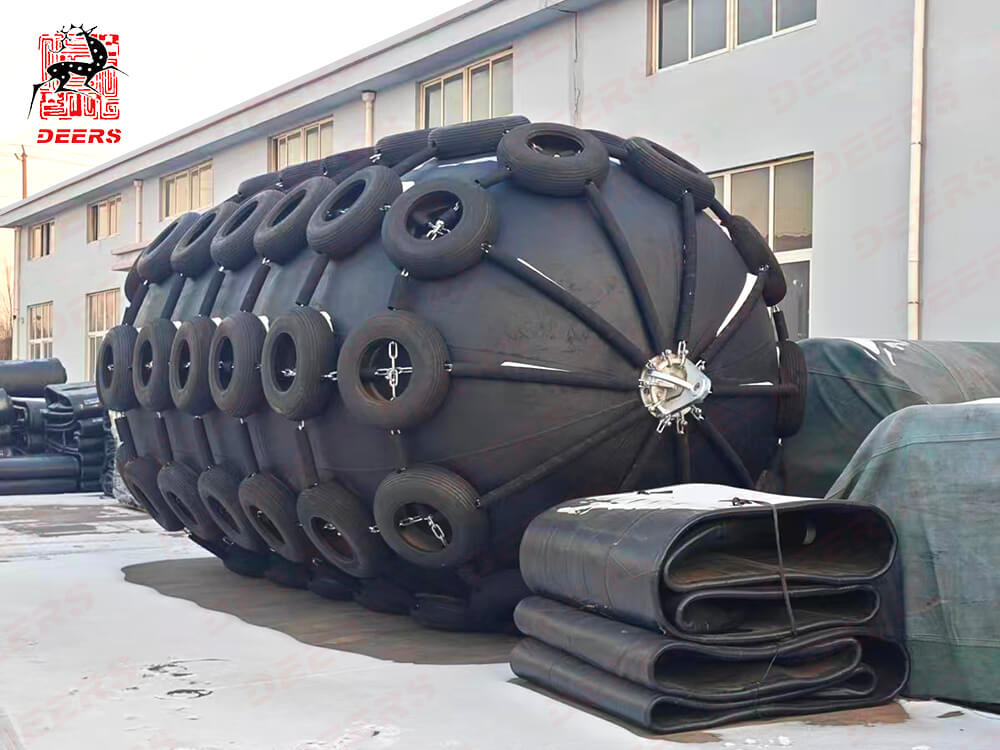
Some localized damage may be repairable, but damage to the reinforcement structure or critical areas may require professional vulcanized repair or complete replacement. Internal pressure should be checked against the manufacturer’s instructions and the applicable 50 kPa or 80 kPa initial-pressure class rather than judged only by appearance.
Foam Filled Fenders
Inspect foam-filled fenders for:
- Deep tears or widespread damage to the outer skin
- Exposed foam core
- Water ingress
- Permanent loss of shape
- Abnormal increase in weight
- Damaged end fittings, chains, or internal components
A small skin cut may be repairable if addressed early. Extensive core damage, water absorption, or permanent deformation can reduce performance and may justify replacement.

Practical Fender Inspection Process
A structured inspection makes replacement decisions more reliable and easier to justify.
Review the design and maintenance history. Collect original drawings, fender specifications, vessel data, previous inspection reports, repair records, and information about abnormal berthing incidents.
Clean the fender system. Marine growth, dirt, and salt deposits can conceal cracks, corrosion, and loose fasteners.
Inspect the complete system. Check the rubber body, panel, UHMW-PE pads, chains, shackles, bolts, anchors, welds, coatings, and the surrounding berth structure.
Photograph and measure defects. Record crack length and depth, worn-pad thickness, corrosion or section loss, panel deformation, and the location of every defect.
Compare findings with approved limits. Use the original manufacturer’s manual, project specification, design assumptions, and applicable inspection procedures. Avoid applying one generic numerical limit to every fender type.
Classify the required action. Mark each finding for continued monitoring, maintenance, component replacement, engineered repair, or immediate operational restriction.
Identify the root cause. Before replacing a fender, determine whether the damage resulted from aging, overloading, installation error, vessel mismatch, chain adjustment, or an abnormal impact.
Regular inspections should also be supplemented by checks after any abnormal berthing event. Maintaining consistent photographs and condition records makes it easier to identify whether a defect is stable or worsening.
Related Products
Next: 1.5×4m Foam Filled Fenders were delivered to Taizhou, Zhejiang
RELATED
- Cell Fenders Successfully Installed in Southeast Asia
- Danforth Anchor: Design, Applications & Size Selection Guide
- DN1000mm Dredge Ball Joints Shipped to Southeast Asia for Dredging Project
- 2.5×4m pneumatic fenders have been successfully installed at the berth
- Repeat Order of D-Type Fenders Successfully Dispatched
- Complete Dredging Pipeline System
- ID900 dredging suction hoses have been delivered for CCCC
- 800H Arch Fenders were delivered for a client in Bangladesh