

When Should Anchor Chains be Replaced?
Date:2026-10-29
Anchor chains play an important role in keeping vessels securely anchored. However, after years of service, chain links may gradually wear down due to friction, corrosion, and repeated loading.
So, when should an anchor chain be replaced? One of the key criteria is whether its diameter has decreased by 12% or more from the required nominal diameter.
Let’s look at how anchor chains are inspected and when replacement becomes necessary.
1. How Often Should Anchor Chains be Inspected?
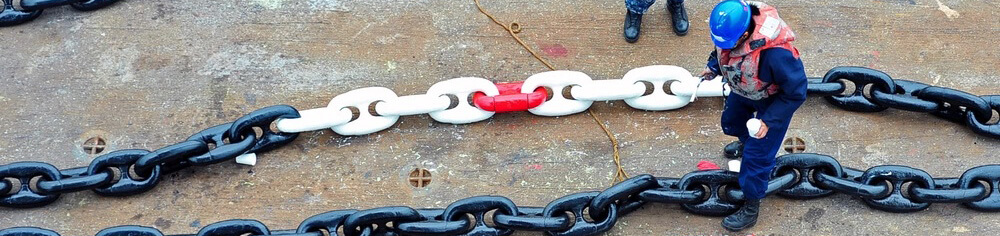
Anchor chains are generally subject to detailed inspection during a vessel’s Special Survey, which is normally carried out every five years. However, the inspection requirements may differ depending on the vessel’s age and the applicable classification society rules.
First Special Survey (Around 5 Years)
During the first Special Survey, anchor chains are normally:
- Fully removed from the chain locker.
- Laid out on the deck or dry dock floor for inspection.
- Visually examined for wear, corrosion, cracks, deformation, and other defects.
Under commonly applied survey requirements, diameter measurements are not routinely required at the first Special Survey unless the chain’s condition or surveyor indicates otherwise.
Second and Subsequent Special Surveys (Around 10 Years and Beyond)
From the second Special Survey onward, anchor chain inspection generally includes both visual examination and diameter measurement. The measured diameter is compared with the required nominal diameter to determine whether the chain remains suitable for service.
2. When Should Anchor Chains be Replaced?
According to IACS Unified Requirement A1.6, for stud-link chain cables used with bower anchors, a chain length must be renewed when the mean diameter of a link at its most worn section has decreased by 12% or more from its required nominal diameter.
For example, consider an anchor chain with a nominal diameter of 50 mm.
| Item | Diameter |
|---|---|
| Nominal chain diameter | 50 mm |
| Maximum permitted reduction (12%) | 6 mm |
| Replacement threshold | 44 mm |
If the measured mean diameter at the most worn section reaches 44 mm or less, the affected chain length must be replaced. This is an important safety requirement, as excessive wear can reduce the strength and reliability of the anchor chain.
3. How is Anchor Chain Diameter Measured?

Anchor chain wear is not always uniform. Some areas of a chain link experience greater friction and may wear faster than others. To assess the wear accurately, measurements should be taken at the most worn section of the link.
Two measurements are taken in perpendicular directions at the same cross-section:
- d1: The minimum diameter at the worn section.
- d2: The diameter measured perpendicular to d1.
The mean diameter is then calculated as: Mean Diameter = (d1 + d2) / 2
The percentage of diameter reduction is calculated as: Diameter Reduction (%) = (Nominal Diameter − Mean Diameter) / Nominal Diameter × 100%
For instance, if the nominal diameter is 50 mm, with d1 = 42 mm and d2 = 46 mm:
- Mean Diameter = (42 + 46) / 2 = 44 mm
- Diameter Reduction = (50 − 44) / 50 × 100% = 12%
In this case, the chain has reached the 12% wear limit and the affected length must be renewed.
4. Other Signs That an Anchor Chain Needs Replacement
Diameter reduction is not the only factor that determines whether an anchor chain is still safe to use.

During inspection, attention should also be paid to:
- Severe corrosion: Deep pitting or extensive corrosion can affect the chain’s integrity.
- Cracks: Visible cracks may indicate structural damage.
- Deformed links: Bent, twisted, or stretched links can affect chain performance.
- Loose or missing studs: Damaged studs may compromise stud-link chain performance.
- Damaged connecting components: Joining shackles, swivels, and other fittings should also be examined.
Even when the measured diameter remains within the allowable limit, significant defects may require repair, further examination, or replacement as determined by the attending surveyor.
Note: Specific inspection and renewal requirements may vary depending on the classification society, vessel type, and applicable regulations. Always refer to the current rules and the attending surveyor’s requirements.
Nanjing Deers Industrial Co., Ltd
Tel:86-25-84507790
Fax:86-25 84660486
Whatsapp:+86 13376094258
Email: benny@chinarubberfender.com
RELATED
- 50 sets of Donut-Shaped Pipe Floats Shipped to Croatia
- Customized V Type Fenders Successfully installed for Berth Replacement Project in Nantong
- ID650 floating hoses Ready for Shipment to Australia
- 150T T-Head Bollards Ready for Delivery to Shandong, China
- Customized Pneumatic Rubber Fenders Perform Excellently in Harsh Conditions
- Minimum Practical Velocity in Dredging Pipelines: Why Does It Matter?
- Pneumatic Fender Accessories Successfully Delivered
- Cell Fenders Successfully Installed in Southeast Asia