

One-Piece vs. Segmented Tugboat Sausage Fenders: Which is Better?
Date:2026-08-26
Tugboats frequently come into contact with vessels, docks, and other marine structures during berthing, pushing, towing, and escort operations. To absorb impact energy and protect the hull, tugboats are equipped with heavy-duty rubber fender systems.
The sausage fender is one of the most commonly used tugboat fenders. Depending on the design and installation requirements, it can be supplied either as one continuous piece or as several separate sections.
Both designs provide effective hull protection, but they differ significantly in maintenance, replacement, transportation, and long-term cost. So, which option is better?
What is One-Piece Sausage Fender?
One-piece sausage fender is manufactured as one continuous length to fit a specific area of the tugboat. It is commonly installed around the bow, stern, or sides of the vessel, where it absorbs repeated compression, friction, and impact.
Its main advantage is structural continuity. With fewer joints, the fender provides a smooth and consistent contact surface and reduces the risk of misalignment between sections.
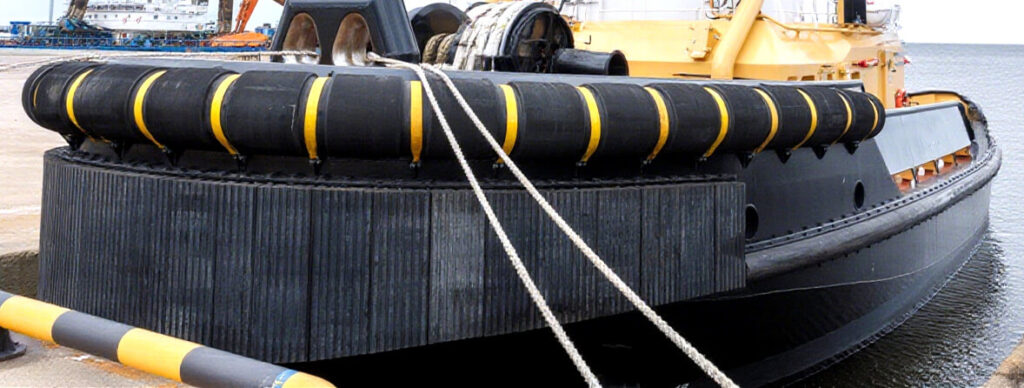
However, the main disadvantage becomes apparent when the fender is damaged.
Wear on a tugboat fender is rarely distributed evenly. Areas that frequently contact other vessels may suffer from abrasion, cracking, tearing, or permanent deformation, while the remaining parts of the fender may still be in good condition.
If the damaged area cannot be repaired locally, the entire one-piece fender may need to be removed and replaced. This means that usable sections are discarded together with the damaged part, increasing material, transportation, installation, and vessel downtime costs.
What is Segmented Sausage Fender?
Segmented sausage fender consists of several individual fender sections installed together along the required area of the tugboat.
When properly designed and installed, the individual sections work together to provide continuous protection. The main difference is that each section can be removed and replaced separately.

For example, if only one section in the middle of the fender system is damaged by repeated impact or abrasion, the operator can replace that specific section. The remaining sections can continue to be used.
This “replace only the damaged section” approach is the primary advantage of a segmented tugboat fender system.
Why are Segmented Tugboat Fenders More Cost-Effective?
1. Replace Only the Damaged Section
This is the most important benefit of a segmented fender system.
Damage to a tugboat fender is often concentrated in a particular contact area. With a segmented system, maintenance teams can remove and replace only the damaged section instead of replacing the entire fender assembly.
This reduces unnecessary material consumption and directly lowers repair costs.
2. Easier Transportation and Handling
A long one-piece fender can be heavy and difficult to transport, lift, store, and position. It may require larger vehicles, lifting equipment, and more working space during installation.
Individual fender sections are generally smaller and easier to handle. This can simplify shipping, on-site movement, installation, and emergency replacement.
3. Shorter Maintenance Time
Replacing an entire one-piece fender may involve removing a large number of fixing components and repositioning a long, heavy product.
With a segmented system, maintenance work can be limited to the damaged area. This may reduce installation time and shorten vessel downtime.
For frequently operated tugboats, reducing downtime can be just as important as reducing the cost of the replacement fender itself.
4. More Convenient Spare-Parts Management
Tugboat operators can keep one or more standard replacement sections in stock. If a fender is damaged, the affected section can be replaced without waiting for a complete, custom-length fender to be manufactured and delivered.
This can be particularly valuable when replacement parts are needed urgently or when vessels operate far from the original fender supplier.
Does One-Piece Sausage Fender Still Have Advantages?
A segmented design is not automatically better in every situation.
A one-piece sausage fender has fewer joints and offers excellent structural continuity. When correctly designed and installed, it provides a smooth contact surface without gaps or possible misalignment between individual sections.
It may therefore be suitable when:
- The installation area is regular and easy to access.
- Continuous contact protection is the main priority.
- Localized wear is unlikely to occur.
- The project requires as few joints as possible.
- The complete fender can be transported and installed without difficulty.
Segmented fenders, meanwhile, require accurate dimensions, reliable fixing arrangements, and careful installation. Poorly installed sections may become misaligned, create uneven contact surfaces, or experience loose connections.
The performance of a segmented system therefore depends on both product quality and proper installation.
Which Type Should You Choose?
If structural continuity and a minimal number of joints are the main priorities, a one-piece sausage fender may be the right choice.
However, if maintenance flexibility, local replacement, easier transportation, and long-term operating costs are more important, a segmented sausage fender will often provide greater value.
This is especially true for tugboats that:
- Operate frequently;
- Experience concentrated wear in specific contact areas;
- Need to minimize maintenance downtime;
- Require faster access to replacement parts;
- Operate in locations where transporting long fenders is difficult; or
- Prioritize lower lifecycle costs.
The decision should not be based only on the initial purchase price. Tugboat owners and operators should also consider installation, transportation, expected wear patterns, replacement-part availability, maintenance labor, and potential vessel downtime.
Related Products
Next: 4.5×9m Pneumatic Fenders Delivered to USA
RELATED
- Customized Pneumatic Rubber Fenders Perform Excellently in Harsh Conditions
- Minimum Practical Velocity in Dredging Pipelines: Why Does It Matter?
- Pneumatic Fender Accessories Successfully Delivered
- Cell Fenders Successfully Installed in Southeast Asia
- Danforth Anchor: Design, Applications & Size Selection Guide
- DN1000mm Dredge Ball Joints Shipped to Southeast Asia for Dredging Project
- 2.5×4m pneumatic fenders have been successfully installed at the berth
- Repeat Order of D-Type Fenders Successfully Dispatched