

Danforth Anchor: Design, Applications & Size Selection Guide
Date:2026-09-24
What is Danforth Anchor?
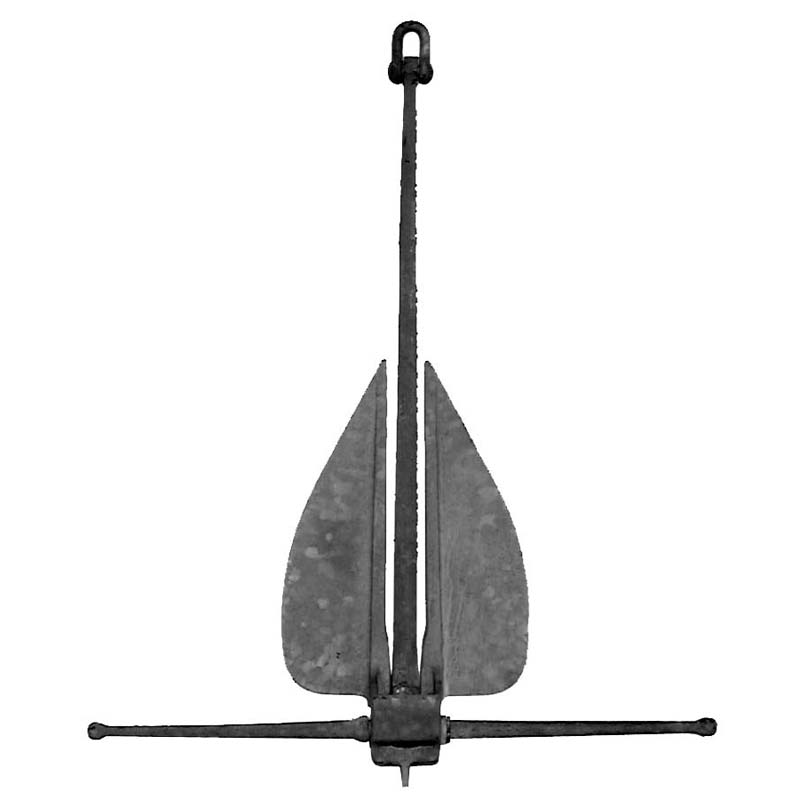
The Danforth anchor, also commonly known as a fluke anchor, is a lightweight anchor design recognized by its long shank, wide stock and two large flat flukes.
Its relatively simple structure and large fluke area allow the anchor to penetrate soft seabeds effectively. For this reason, Danforth anchors are commonly selected for applications where the seabed consists mainly of sand or mud.
Compared with many heavier traditional anchor designs, a Danforth anchor can provide strong holding performance relative to its own weight under suitable seabed conditions. The basic design normally consists of four main parts: the shank, stock, crown and flukes.
How Does a Danforth Anchor Work?
The holding performance of a Danforth anchor mainly comes from its two wide flukes.
After the anchor reaches the seabed and the anchor line or chain is pulled horizontally, the stock helps position the anchor so that the flukes can engage with the bottom. As the pulling force increases, the flukes penetrate deeper into the seabed and create resistance against vessel movement.
The large surface area of the flukes is one of the main reasons Danforth-style anchors can provide a high holding-power-to-weight ratio in suitable seabeds.
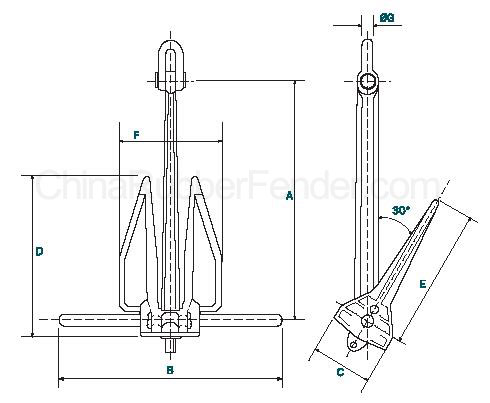
Your drawing is especially useful in this section because customers can clearly see the overall structure and the relationship between dimensions A, B, C, D, E and F.
Where does it work best?
Danforth anchors are particularly suitable for sand and mud bottoms.
When the flukes can penetrate the seabed properly, the anchor develops holding force through the resistance of the surrounding soil. Published guidance for Danforth and fluke-style anchors consistently identifies sand and soft mud as their strongest operating environments.
Start with the bottom conditions.
A Danforth-style anchor is not a universal choice for every seabed. Confirm site conditions before selecting the model and weight.
| SEABED | GENERAL SUITABILITY |
|---|---|
| Sand | Well suited |
| Mud / sand & mud | Generally suited |
| Very soft mud | Design dependent |
| Rock | Poor |
| Grass / weed | Poor |
| Hard clay | Limited |
How to Choose the Right Danforth Anchor Size?
Anchor weight alone does not define suitability. Establish the required holding performance first, then review these eight factors with your project team.
Vessel characteristics
Consider displacement, dimensions and windage.
Environmental loads
Define wind, current, waves and exposure.
Seabed conditions
Confirm soil type and likely penetration.
Water depth & scope
Review depth, tide and the planned rode length.
Operating duty
Distinguish temporary anchoring from sustained mooring.
Chain, rode & shackle
Check compatibility and working load requirements.
Handling & stowage
Verify deck space, lifting capacity and clearances.
Project requirements
Confirm design criteria and engineering approval.
Danforth Anchor Specifications
Nominal weight: lbs · Dimensions: mm. On mobile, swipe the table sideways to see all columns.
| Weight (lbs) | A (mm) | B (mm) | C (mm) | D (mm) | E (mm) | F (mm) | Shackle model |
|---|---|---|---|---|---|---|---|
| 100 | 159 | 322 | 714 | 485 | 800 | 219 | a4 |
| 150 | 183 | 372 | 793 | 560 | 926 | 253 | a5 |
| 200 | 203 | 412 | 874 | 621 | 995 | 281 | a6 |
| 250 | 225 | 457 | 960 | 689 | 1075 | 312 | a6 |
| 300 | 228 | 461 | 1000 | 706 | 1166 | 314 | a7 |
| 400 | 257 | 522 | 1090 | 788 | 1284 | 356 | a8 |
| 500 | 274 | 554 | 1180 | 836 | 1380 | 378 | a9 |
| 600 | 290 | 588 | 1253 | 888 | 1466 | 401 | a9 |
| 750 | 314 | 635 | 1350 | 958 | 1578 | 433 | a9 |
| 1,000 | 344 | 694 | 1488 | 1060 | 1739 | 472 | a11 |
| 1,250 | 367 | 741 | 1603 | 1135 | 1864 | 505 | a12 |
| 1,500 | 396 | 800 | 1703 | 1207 | 1988 | 545 | a12 |
| 2,000 | 438 | 888 | 1875 | 1336 | 2190 | 604 | a14 |
| 2,500 | 470 | 950 | 2020 | 1432 | 2300 | 647 | a14 |
| 2,625 | 470 | 950 | 2020 | 1432 | 2300 | 647 | a14 |
| 2,750 | 485 | 960 | 2120 | 1432 | 2335 | 650 | a14 |
| 3,000 | 502 | 1033 | 2146 | 1575 | 2396 | 710 | a14 |
| 3,500 | 550 | 1111 | 2265 | 1677 | 2515 | 757 | a15 |
| 4,000 | 552 | 1114 | 2365 | 1680 | 2623 | 759 | a15 |
| 5,000 | 595 | 1200 | 2480 | 1811 | 2850 | 818 | a16 |
| 6,000 | 630 | 1274 | 2680 | 1920 | 3164 | 866 | a17 |
| 6,600 | 652 | 1317 | 2792 | 1986 | 3260 | 897 | a19 |
| 8,000 | 692 | 1398 | 2970 | 2109 | 3475 | 971 | a19 |
| 9,000 | 715 | 1448 | 3080 | 2200 | 3490 | 990 | a20 |
| 10,000 | 735 | 1484 | 3200 | 2270 | 3591 | 1010 | a21 |
| 15,000 | 851 | 1700 | 3680 | 2610 | 4100 | 1160 | a23 |
| 20,000 | 936 | 1870 | 4050 | 2870 | 4510 | 1276 | a26 |
| 30,000 | 1136 | 2250 | 4900 | 3400 | 5400 | 1520 | a30 |
| 35,000 | 1208 | 2414 | 5250 | 3670 | 5830 | 1642 | a31 |
| 40,000 | 1286 | 2588 | 5625 | 3930 | 6250 | 1758 | a32 |
| 45,000 | 1378 | 2745 | 5968 | 4172 | 6610 | 1867 | a33 |
| 50,000 | 1450 | 2890 | 6282 | 4393 | 6950 | 1965 | a34 |
Drawing / table check: Dimension letters in the supplied drawing and table appear inconsistent in scale. Original labels and values are retained. Confirm their correspondence before ordering or fabrication. Shackle model codes are not load ratings.
Why Choose Danforth Anchors?
High holding power relative to weight
The wide flukes provide a large seabed contact area while keeping the overall anchor structure relatively lightweight.
Good penetration in sand and mud
The fluke geometry allows the anchor to bury into soft seabeds effectively.
Simple and proven structure
Its shank, stock and twin-fluke design is straightforward and widely used in marine anchoring applications.
Wide range of sizes
Different nominal weights can be selected according to vessel and project requirements.
Danforth anchors are therefore a practical option when the operating environment and seabed conditions match the characteristics of the anchor.
Planning your anchor requirement?
We are here to help.
RELATED
- DN1000mm Dredge Ball Joints Shipped to Southeast Asia for Dredging Project
- 2.5×4m pneumatic fenders have been successfully installed at the berth
- Repeat Order of D-Type Fenders Successfully Dispatched
- Complete Dredging Pipeline System
- ID900 dredging suction hoses have been delivered for CCCC
- 800H Arch Fenders were delivered for a client in Bangladesh
- ID600 Floating Hoses Ready for Delivery to Tianjin Dredging Company
- How are Oil Tankers Classified by Size?