

How to Select Anchor Chain Types and Grades for the Ship
Date:2026-04-30
Anchor chain is a key load-bearing component in ship mooring and offshore operations. Different types and strength grades of anchor chains vary in structural design and mechanical performance. Proper selection is critical to anchoring safety and operational stability.
1. Anchor Chain Types
The structural design of chain links directly affects mechanical performance. Based on the presence of an internal stud, anchor chains are generally classified into stud chains and studless chains for different operational conditions.
1) Stud Chain
Features: A stud is installed inside each link to effectively limit deformation and prevent twisting or entanglement.
Advantages: High structural stability, strong impact resistance and excellent wear performance; suitable for long-term heavy-duty service.
Applications: Mainly used in mooring systems for medium and large vessels and offshore structures.
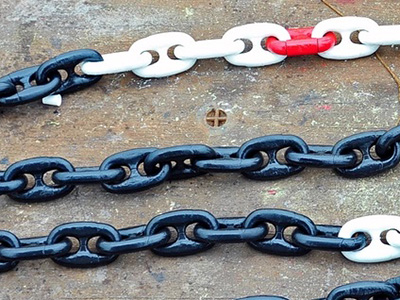
2) Studless Chain
Features: No internal stud, resulting in a simpler structure, higher flexibility and lower self-weight.
Advantages: Flexible handling, good adaptability and easy installation.
Applications: Commonly used for small vessels, buoy mooring systems and auxiliary offshore applications.
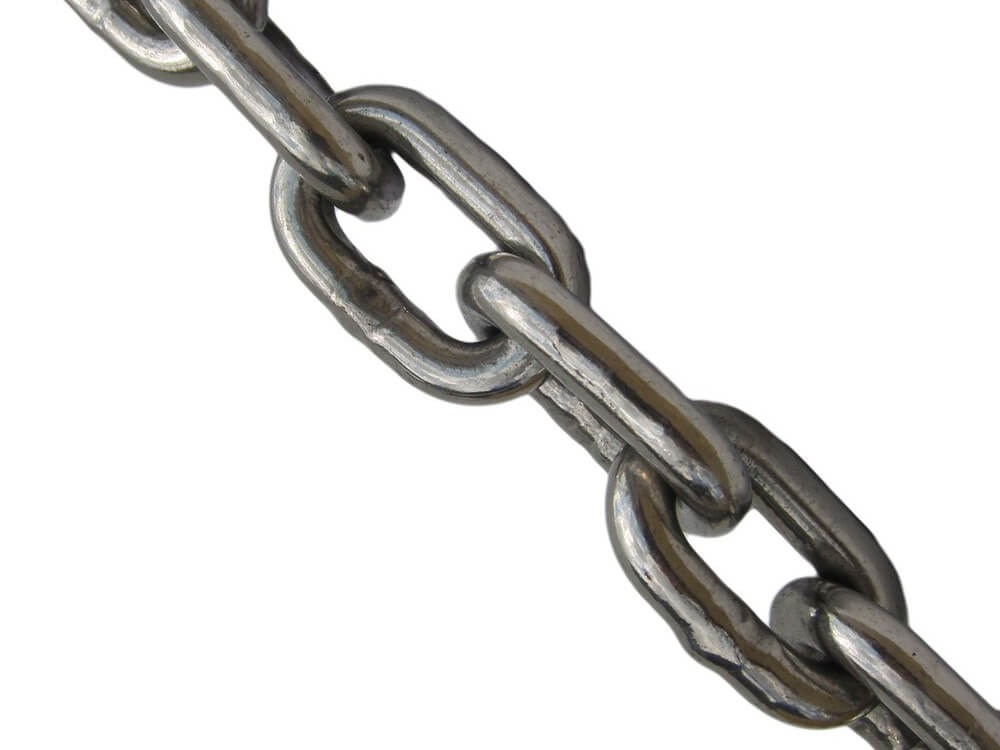
2. Anchor Chain Grade Classification
In addition to structural types, anchor chains are also classified by strength grades. Anchor chain grades are defined in accordance with ISO 1704 and IACS unified requirements and are classified into U1, U2 and U3.
Higher grades provide increased tensile strength, impact toughness and fatigue resistance. The grades are specified as follows:
| Grade | Characteristics | Applications |
|---|---|---|
| U1 (Grade 1) | Ordinary carbon steel with lower strength and fatigue resistance | Light-duty anchoring for small vessels and auxiliary mooring |
| U2 (Grade 2) | Heat-treated steel with improved overall mechanical properties | Conventional anchoring for medium-sized vessels under normal sea conditions |
| U3 (Grade 3) | High-strength steel with superior impact and fatigue performance | Large vessels, deep-water mooring and harsh marine environments |
3. Selection Principles
Anchor chain selection shall be based on both structural type and strength grade. Structural type determines link stability and deformation resistance, while strength grade determines mechanical performance and safety margin.
In practical engineering applications, selection shall also consider vessel type, anchoring conditions and relevant technical requirements to ensure long-term safety and reliability of the mooring system under operational conditions.
Next: 300H V type fenders were well installed on the tourist pier
RELATED
- Cell Fenders Successfully Installed in Southeast Asia
- Danforth Anchor: Design, Applications & Size Selection Guide
- DN1000mm Dredge Ball Joints Shipped to Southeast Asia for Dredging Project
- 2.5×4m pneumatic fenders have been successfully installed at the berth
- Repeat Order of D-Type Fenders Successfully Dispatched
- Complete Dredging Pipeline System
- ID900 dredging suction hoses have been delivered for CCCC
- 800H Arch Fenders were delivered for a client in Bangladesh