

Ship Anchoring Equipment: Components, Functions & How It Works
Stable anchoring does not rely on anchor weight alone. It depends on an integrated load-bearing system — the anchor, anchor chain, hawse pipe, chain stopper, and anchor windlass — working together to generate holding power, transfer loads, and secure the vessel against wind, waves, and currents.
This page explains each component, the main anchoring functions, and the working principles behind reliable anchoring.
1. Main Components of Ship Anchoring Equipment
Ship anchoring equipment mainly consists of an anchor, anchor chain, hawse pipe, chain stopper, anchor windlass, and associated accessories.
The diagram below illustrates a typical ship anchoring equipment arrangement, providing a clear overview of the installation positions and relationships between different components.

The following sections introduce the structure, functions, and roles of each component.
1.1 Anchor
The anchor is the primary component of the anchoring system responsible for generating holding power. By embedding its flukes into suitable seabed material and utilizing the resistance of the surrounding soil, the anchor restricts vessel movement under external environmental loads.
A ship anchor typically consists of a shank, flukes, crown, and connecting shackle, although its specific structure varies depending on the anchor type.
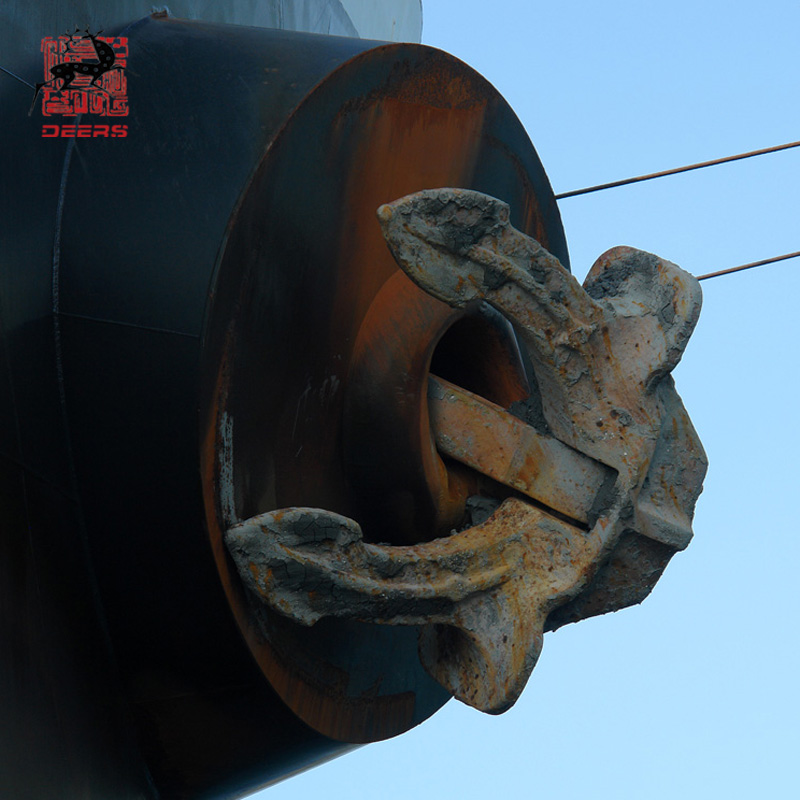
Common types of marine anchors include:
- Hall Anchor
- Spek Anchor
- Pool Anchor
- AC-14 Anchor
- Danforth Anchor
- Other High Holding Power (HHP) Anchors
Different anchor types vary in structural design, penetration capability, holding power-to-weight ratio, and suitability for different seabed conditions. Therefore, anchor selection should be based on the vessel type and specific operational requirements.
1.2 Anchor Chain
The anchor chain is an essential load-bearing component connecting the anchor to the vessel. Its primary function is to transfer anchoring loads while improving the loading conditions of the anchor through its own weight.
The main functions of an anchor chain include:
- Connecting the anchor to the ship's anchoring equipment.
- Transferring loads between the anchor and the vessel.
- Reducing the vertical uplift force acting on the anchor under appropriate chain length and loading conditions.
- Cushioning some of the dynamic loads caused by vessel movement.
- Providing additional holding resistance through friction between the seabed and the portion of the chain resting on it.
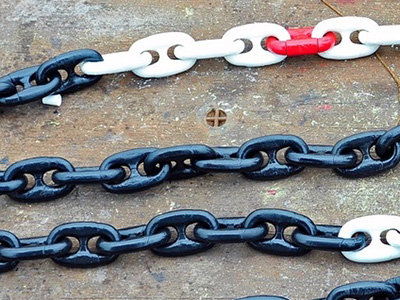
Based on their link structure, anchor chains can be divided into two main categories:
- Stud Link Anchor Chain — Each chain link contains a central stud that improves structural stability. It is widely used in the anchoring systems of large commercial vessels.
- Studless Anchor Chain — The chain links have no central studs and feature a relatively simple structure. It is commonly used on certain smaller vessels and in offshore mooring systems.
1.3 Hawse Pipe
The hawse pipe is a passage connecting the forecastle deck to the exterior of the ship's hull. It guides the anchor chain during deployment and retrieval and accommodates the anchor shank when the anchor is stowed.
A hawse pipe typically consists of three main parts: the deck opening, the hull-side opening, and the pipe body.
A properly designed hawse pipe helps reduce friction and minimizes the risk of chain jamming during anchoring operations. It also facilitates smooth anchor deployment and retrieval while allowing the anchor to fit securely against the hull when stowed.
1.4 Chain Stopper
The chain stopper is generally installed between the anchor windlass and the hawse pipe. It is an important mechanical device used to secure the anchor chain and withstand anchoring loads.
When the vessel is at anchor, the chain stopper transfers loads from the anchor chain to the ship's hull structure through its supporting foundation, reducing the loads acting on the windlass and its braking system.
During navigation, the chain stopper works together with other anchor securing devices to prevent unintended movement of the anchor and chain, reducing the risk of accidental anchor release or loss.

Common types include guillotine-type chain stoppers and roller-bar chain stoppers. Their load-bearing capacity should match the anchor chain specifications and vessel design requirements.
1.5 Anchor Windlass
The anchor windlass is a mechanical device used to control the deployment and retrieval of the anchor and anchor chain. It is typically installed on the forecastle deck.
An anchor windlass generally consists of a drive system, reduction gearbox, chain wheel (also known as a wildcat or gypsy), clutch, and braking system.

Its main functions include:
- Controlling the deployment of the anchor and anchor chain.
- Retrieving the anchor and anchor chain.
- Controlling chain payout and retrieval speeds.
- Restricting chain movement through the braking system.
- Assisting vessel mooring operations when equipped with warping heads or mooring drums.
Based on their driving systems, marine anchor windlasses are mainly classified into electric anchor windlasses and hydraulic anchor windlasses.
1.6 Other Anchoring Equipment and Accessories
In addition to the main components mentioned above, a complete ship anchoring system includes various auxiliary devices and accessories for chain storage, connection, securing, and maintenance.
| Equipment / Accessories | Main Functions |
|---|---|
| Chain Pipe / Spurling Pipe | Guides the anchor chain between the windlass and the chain locker. |
| Chain Locker | Stores the anchor chain after retrieval. |
| Bitter End Release Gear | Secures the inboard end of the anchor chain and allows it to be released when necessary in an emergency. |
| Anchor Shackle | Connects the anchor to the anchor chain assembly. |
| Kenter Shackle | Connects individual lengths of anchor chain. |
| Swivel | Allows relative rotation between connected components, reducing chain twisting. |
| Anchor Lashing Device | Provides additional securing of the anchor during navigation. |
| Anchor Chain Washing System | Removes mud, sand, and other debris from the anchor chain during retrieval. |
Although these accessories differ in structure and function, they are all important to the proper operation and reliability of the ship anchoring system.
2. Main Functions of Ship Anchoring Equipment
Depending on operational requirements, the functions of ship anchoring equipment can be divided into three main categories: normal anchoring, assisting ship maneuvering, and emergency anchoring.
2.1 Normal Anchoring
Normal anchoring is the most basic and common application of ship anchoring equipment.
When a vessel needs to remain temporarily in a designated area but is not ready or able to berth, anchoring helps restrict vessel drift and maintain its position within a suitable area.
Typical applications include:
- Waiting for suitable tidal conditions.
- Waiting for berth availability.
- Waiting for pilots to board.
- Waiting for quarantine clearance and port inspections.
- Conducting cargo loading and unloading at designated anchorages.
- Receiving supplies or transferring personnel.
- Temporarily stopping at a suitable anchorage.
During anchoring, the anchoring equipment must withstand external environmental loads generated by wind, waves, and currents.
2.2 Assisting Ship Maneuvering
In addition to conventional anchoring, anchors can also serve as auxiliary maneuvering equipment under certain vessel and port conditions.
During suitable low-speed maneuvers, the resistance generated by an anchor can help control the vessel's forward movement, bow heading, and lateral movement, assisting with berthing or turning operations.
Such operations depend on vessel speed, water depth, seabed conditions, wind direction, currents, and equipment capacity. They must therefore be carefully assessed and performed by qualified maritime personnel.
2.3 Emergency Anchoring
In certain emergency situations, ship anchoring equipment can help reduce the risk or consequences of maritime accidents.
Typical applications include:
- Restricting vessel drift following propulsion or steering system failure.
- Helping reduce the risk of collision or grounding under suitable conditions.
- Assisting in stabilizing a grounded vessel or supporting refloating operations under specific circumstances.
Important
Conventional ship anchoring equipment is primarily designed for temporary anchoring rather than emergency braking at high speeds. Deploying an anchor when a vessel has considerable momentum or is operating in severe sea conditions may subject the anchor chain, windlass, chain stopper, and hull structure to excessive loads. Emergency anchoring must therefore take actual operating conditions and equipment design limitations into consideration.
3. Working Principles of Ship Anchoring Equipment
Ship anchoring does not rely solely on the weight of the anchor. Instead, it depends on the holding power generated between the anchor and the seabed, together with the coordinated operation of the anchor chain and other anchoring equipment, to resist external loads from wind, waves, and currents.

The anchoring process can generally be divided into four main stages.
- Anchor Descends and Reaches the Seabed. During anchor deployment, the anchor descends under gravity as the anchor chain is paid out until the anchor reaches the seabed, establishing the conditions necessary for generating holding power.
- Anchor Flukes Penetrate the Seabed and Develop Holding Power. As the vessel moves relative to the anchor, the anchor chain gradually comes under tension and pulls the anchor along the seabed. Under suitable seabed and loading conditions, the anchor flukes penetrate the seabed material and generate holding power through soil resistance, restricting vessel movement.
- Anchor Chain Forms a Catenary and Transfers Loads. Under appropriate chain length and loading conditions, the anchor chain forms a catenary due to its own weight. This helps maintain a more horizontal pulling direction at the anchor, reducing vertical uplift forces and cushioning some dynamic loads. Meanwhile, the portion of the anchor chain resting on the seabed can provide additional resistance through friction.
- Stable Anchoring Is Established. When the holding capacity of the anchoring system is sufficient to resist external loads from wind, waves, and currents, the vessel can maintain a relatively stable anchoring position. If external loads exceed the holding capacity of the system, the anchor may move along the seabed, a phenomenon known as anchor dragging.
4. Key Factors Affecting Ship Anchoring Performance
Ship anchoring performance is not determined by a single component. It depends on a combination of anchor design, anchor chain configuration, seabed conditions, environmental loads, and equipment condition.
| Influencing Factor | Impact on Anchoring Performance |
|---|---|
| Anchor Type and Design | Different anchor designs offer different penetration capabilities, holding characteristics, and suitability for various seabed conditions. |
| Anchor Weight | Influences anchor descent, penetration, and holding performance, but is not the only factor determining holding power. |
| Anchor Chain Specifications and Weight | Affect system load-bearing capacity, catenary shape, and the ability to cushion dynamic loads. |
| Length of Anchor Chain Paid Out | Affects the anchor's loading direction, catenary shape, and vessel swinging radius. |
| Seabed Conditions | Different seabed materials, such as mud, sand, clay, gravel, and rock, directly affect anchor penetration and holding power. |
| Water Depth | Influences the required anchor chain length and the loading conditions of the anchoring system. |
| Wind, Waves, and Currents | Affect the external environmental loads that the anchoring system must withstand. |
| Vessel Size and Windage Area | Influence the environmental loads acting on the vessel during anchoring. |
| Equipment Compatibility | The specifications and load-bearing capacities of anchors, chains, shackles, chain stoppers, and windlasses must be properly matched. |
| Equipment Condition | Wear, corrosion, cracks, and deformation may reduce equipment strength and operational reliability. |
Therefore, a heavier anchor, a larger-diameter anchor chain, or a longer anchor chain does not necessarily guarantee better anchoring performance. Equipment configuration should take vessel type, vessel dimensions, operating conditions, and applicable classification society requirements into consideration.
Tips
- Treat anchoring equipment as an integrated system. Reliability depends on the compatibility of the anchor, anchor chain, shackles, chain stopper, windlass, and hull structure — not just anchor holding power.
- Look beyond weight and dimensions. When selecting marine anchors and anchor chains, also consider load-bearing capacity, manufacturing quality, inspection results, and classification society requirements.
- Inspect regularly. Check anchors, anchor chains, and accessories for wear, corrosion, cracks, and deformation, and maintain windlasses and chain stoppers properly.
Proper maintenance of the complete anchoring system is essential for maintaining anchoring safety and extending equipment service life.
Frequently Asked Questions
What are the main components of ship anchoring equipment?
Ship anchoring equipment consists of an anchor, anchor chain, hawse pipe, chain stopper, anchor windlass, and auxiliary components such as the chain locker, shackles, swivel, and bitter end release gear. These components work together to ensure reliable anchor deployment, retrieval, and load transfer.
How does a ship anchor hold a vessel in place?
A ship anchor holds a vessel in place primarily by embedding its flukes into suitable seabed material and generating holding power through soil resistance. The anchor chain helps maintain a more horizontal pulling direction at the anchor, improving anchoring stability against wind, waves, and currents.
What is the function of an anchor chain in a ship anchoring system?
The anchor chain connects the anchor to the vessel and transfers anchoring loads. Its weight helps form a catenary, reducing the vertical uplift force acting on the anchor and cushioning dynamic loads. The portion of the chain resting on the seabed can also provide additional resistance through friction.
What is the difference between an anchor windlass and a chain stopper?
An anchor windlass is a mechanical device used to deploy, retrieve, and control the anchor chain. A chain stopper is designed to secure the anchor chain and transfer anchoring loads to the ship's hull structure, reducing the load acting on the windlass and its braking system.
What factors affect the holding power of a ship anchor?
The holding power of a ship anchor is influenced by its type, weight, fluke design, seabed conditions, anchor chain length, and pulling direction. Environmental conditions such as wind, waves, and currents also affect overall anchoring stability. A heavier anchor does not necessarily provide better holding performance under all conditions.